




These docs are for Cribl Stream 4.3 and are no longer actively maintained.
See the latest version (4.20).
Job Limits
You can configure global limits that optimize the execution of all Collectors and scheduled jobs (including Cribl Stream system tasks). You access and set these limits as follows.
Single-instance deployments: Settings > System > General Settings > Limits > Jobs.
These limits apply to all Worker Processes.
Distributed deployments: From the Leader, [select a Worker Group] > Group Settings > System > General Settings > Limits > Jobs.
These limits are applied at the Worker Group level (except where noted), and trickle down to individual Worker Processes in the Group.
Limits Available
The following controls are available at the UI locations listed above.
Job Limits
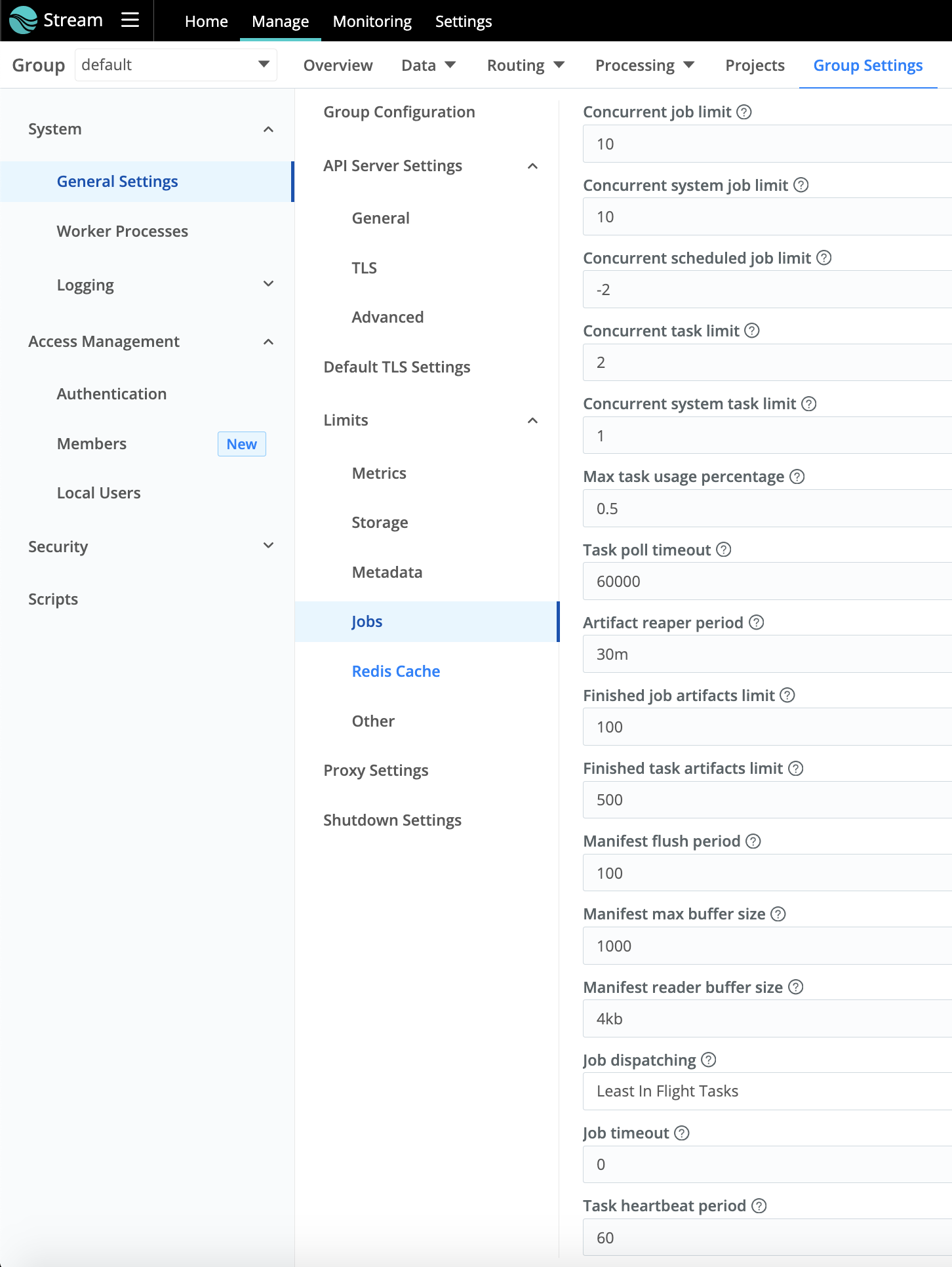
Concurrent Job Limit: The total number of jobs that can run concurrently. Defaults to 10.
Concurrent System Job Limit: The total number of system jobs that can run concurrently. Defaults to 10. Minimum 1.
Concurrent Scheduled Job Limit: The total number of scheduled jobs that can run concurrently. This limit is set as an offset relative to the Concurrent Job Limit. Defaults to -2.
Skipped jobs indicate that a Group’s Concurrent Job Limit has been reached or exceeded. Increase this limit to reduce the number of skippable jobs. For resource-intensive jobs, this might require deploying more Worker Nodes.
Task Limits
Concurrent Task Limit: The total number of tasks that a Worker Process can run concurrently. Defaults to 2. Minimum 1.
Concurrent System Task Limit: The number of system tasks that a Worker Process can run concurrently. Defaults to 1. Minimum 1.
Max Task Usage Percentage: Value, between 0 and 1, representing the percentage of total tasks on a Worker Process that any single job may consume. Defaults to 0.5 (i.e., 50%).
Task Poll Timeout: The number of milliseconds that a Worker’s task handler will wait to receive a task, before retrying a request for a task. Defaults to 60000 (i.e., 60 seconds). Minimum 10000 (10 seconds).
Completion Limits
Artifact Reaper Period: Interval on which Cribl Stream attempts to reap jobs’ stale disk artifacts. Defaults to 30m.
Finished Job Artifacts Limit: Maximum number of finished job artifacts to keep on disk. Defaults to 100. Minimum 0.
Finished Task Artifacts Limit: Maximum number of finished task artifacts to keep on disk, per job, on each Worker Node. Defaults to 500. Minimum 0.
Task Manifest and Buffering Limits
Manifest Flush Period: The rate (in milliseconds) at which a job’s task manifest should be refreshed. Defaults to 100 ms. Minimum 100, maximum 10000.
Manifest Max Buffer Size: The maximum number of tasks that the task manifest can hold in memory before flushing to disk. Defaults to 1000. Minimum 100, maximum 10000.
Manifest Reader Buffer Size: The number of bytes that the task manifest reader should pull from disk. Defaults to 4kb.
Job Dispatching: The method by which tasks are assigned to Worker Processes. Defaults to Least In-Flight Tasks, to optimize available capacity. Round Robin is also available.
Job Timeout: Maximum time a job is allowed to run. Defaults to 0, for unlimited time. Units are seconds if not specified. Sample entries: 30, 45s, 15m.
Task Heartbeat Period: The heartbeat period (in seconds) for tasks to report back to the Leader/API. Defaults to 60 seconds. Minimum 60.